【背景】
之前已经利用并修改原先的:
然后实现了,支持HART协议,从某Android PAD经过USB OTG转接头和HART猫,最终连通了某HART设备:
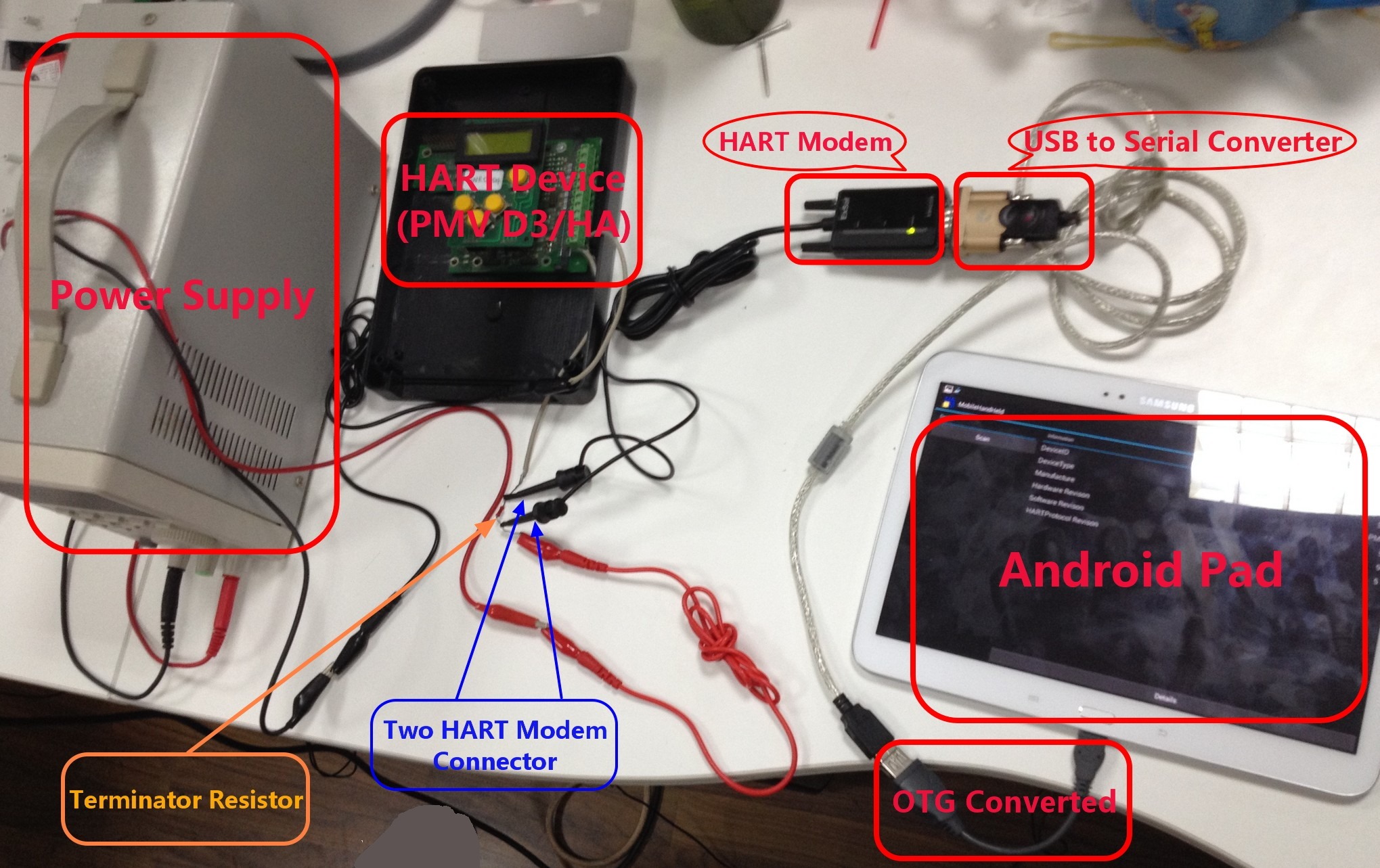
可以用DigiView抓取出对应的RTS,CTS等信号,实现了HART的硬件通讯了。
且之前已整理了一点资料:
【整理】Android平台下的FTDI的USB转串口(Serial, CDC)驱动
但是关于移植细节,并没记录。
现直接贴出代码,供参考:
(1)代码文件:
/UsbSerialLibrary/src/com/hoho/android/usbserial/driver/FtdiSerialDriver.java
修改后的源码:
/* Copyright 2011 Google Inc.
 *
 * This library is free software; you can redistribute it and/or
 * modify it under the terms of the GNU Lesser General Public
 * License as published by the Free Software Foundation; either
 * version 2.1 of the License, or (at your option) any later version.
 *
 * This library is distributed in the hope that it will be useful,
 * but WITHOUT ANY WARRANTY; without even the implied warranty of
 * MERCHANTABILITY or FITNESS FOR A PARTICULAR PURPOSE.  See the GNU
 * Lesser General Public License for more details.
 *
 * You should have received a copy of the GNU Lesser General Public
 * License along with this library; if not, write to the Free Software
 * Foundation, Inc., 51 Franklin Street, Fifth Floor, Boston, MA  02110-1301,
 * USA.
 *
 * Project home page: http://code.google.com/p/usb-serial-for-android/
 */

package com.hoho.android.usbserial.driver;

import android.hardware.usb.UsbConstants;
import android.hardware.usb.UsbDevice;
import android.hardware.usb.UsbDeviceConnection;
import android.hardware.usb.UsbEndpoint;
import android.hardware.usb.UsbRequest;
import android.util.Log;

import com.hoho.android.usbserial.util.HexDump;

import java.io.IOException;
import java.nio.ByteBuffer;
import java.util.LinkedHashMap;
import java.util.Map;

/**
 * A {@link CommonUsbSerialDriver} implementation for a variety of FTDI devices
 * <p>
 * This driver is based on
 * <a href="http://www.intra2net.com/en/developer/libftdi">libftdi</a>, and is
 * copyright and subject to the following terms:
 *
 * <pre>
 *   Copyright (C) 2003 by Intra2net AG
 *
 *   This program is free software; you can redistribute it and/or modify
 *   it under the terms of the GNU Lesser General Public License
 *   version 2.1 as published by the Free Software Foundation;
 *
 *   [email protected]
 *   http://www.intra2net.com/en/developer/libftdi
 * </pre>
 *
 * </p>
 * <p>
 * Some FTDI devices have not been tested; see later listing of supported and
 * unsupported devices. Devices listed as "supported" support the following
 * features:
 * <ul>
 * <li>Read and write of serial data (see {@link #read(byte[], int)} and
 * {@link #write(byte[], int)}.
 * <li>Setting baud rate (see {@link #setBaudRate(int)}).
 * </ul>
 * </p>
 * <p>
 * Supported and tested devices:
 * <ul>
 * <li>{@value DeviceType#TYPE_R}</li>
 * </ul>
 * </p>
 * <p>
 * Unsupported but possibly working devices (please contact the author with
 * feedback or patches):
 * <ul>
 * <li>{@value DeviceType#TYPE_2232C}</li>
 * <li>{@value DeviceType#TYPE_2232H}</li>
 * <li>{@value DeviceType#TYPE_4232H}</li>
 * <li>{@value DeviceType#TYPE_AM}</li>
 * <li>{@value DeviceType#TYPE_BM}</li>
 * </ul>
 * </p>
 *
 * @author mike wakerly ([email protected])
 * @see <a href="http://code.google.com/p/usb-serial-for-android/">USB Serial
 * for Android project page</a>
 * @see <a href="http://www.ftdichip.com/">FTDI Homepage</a>
 * @see <a href="http://www.intra2net.com/en/developer/libftdi">libftdi</a>
 */
public class FtdiSerialDriver extends CommonUsbSerialDriver {
    private static final int DEFAULT_BAUD_RATE = 115200;
    private static final int DEFAULT_DATA_BITS = DATABITS_8;
    private static final int DEFAULT_PARITY = PARITY_NONE;
    private static final int DEFAULT_STOP_BITS = STOPBITS_1;

    public static final int USB_TYPE_STANDARD = 0x00 << 5;
    public static final int USB_TYPE_CLASS = 0x00 << 5;
    public static final int USB_TYPE_VENDOR = 0x00 << 5;
    public static final int USB_TYPE_RESERVED = 0x00 << 5;

    public static final int USB_RECIP_DEVICE = 0x00;
    public static final int USB_RECIP_INTERFACE = 0x01;
    public static final int USB_RECIP_ENDPOINT = 0x02;
    public static final int USB_RECIP_OTHER = 0x03;

    public static final int USB_ENDPOINT_IN = 0x80;
    public static final int USB_ENDPOINT_OUT = 0x00;

    public static final int USB_WRITE_TIMEOUT_MILLIS = 5000;
    public static final int USB_READ_TIMEOUT_MILLIS = 5000;


    /*
     * add support for RTS and DTR, by Crifan Li
     */
    private boolean mRts = false;
    private boolean mDtr = false;

    //http://asf.atmel.com/docs/2.9.0/avr32.services.usb.cdc.example.evk1100.asfv1/html/cdc_8h_source.html
    private static final int SEND_ENCAPSULATED_COMMAND  = 0x00;
    private static final int GET_ENCAPSULATED_COMMAND   = 0x01;

    //http://fenrir.naruoka.org/download/autopilot/external/TinyFeather/DSP/autopilot/peripheral/usb_cdc.cpp
    /**
     * Set_Line_Coding
     *
     * Unload the line coding structure (7 bytes) sent in the data stage.
     * Apply this setting to the UART
     * Flush the communication buffer
     *
     * Line Coding Structure (7 bytes)
     * 0-3 dwDTERate    Data terminal rate (baudrate), in bits per second (LSB first)
     * 4   bCharFormat  Stop bits: 0 - 1 Stop bit, 1 - 1.5 Stop bits, 2 - 2 Stop bits
     * 5   bParityType  Parity:    0 - None, 1 - Odd, 2 - Even, 3 - Mark, 4 - Space
     * 6   bDataBits    Data bits: 5, 6, 7, 8, 16
     */
    private static final int SET_LINE_CODING = 0x20;  // USB CDC 1.1 section 6.2
    /**
     * Get_Line_Coding
     *
     * Return the line coding structure
     */
    private static final int GET_LINE_CODING = 0x21;
    /**
     * Set_ControlLine_State
     *
     * Set/reset RTS/DTR according to wValue
     * wValue
     *  bit 1  RTS
     *  bit 0  DTR
     */
    private static final int SET_CONTROL_LINE_STATE = 0x22;
    /**
     * Send_Break
     *
     * Send break from UART TX port, for wValue (msec) duration.
     * wValue
     *  0xFFFF: continuous break
     *  0x0000: stop break
     */
    private static final int SEND_BREAK = 0x23;

    //SET_CONTROL_LINE_STATE bit fields
    //http://www.lvr.com/usb_virtual_com_port.htm
    //http://fenrir.naruoka.org/download/autopilot/external/TinyFeather/DSP/autopilot/peripheral/usb_cdc.cpp
    public static final int SET_CONTROL_LINE_BITS_DTR = 0x01 << 0; //bit0
    public static final int SET_CONTROL_LINE_BITS_RTS = 0x01 << 1; //bit1

    //private static final int USB_RECIP_INTERFACE = 0x01;

    //refer:
    //http://www.cs.fsu.edu/~baker/devices/lxr/http/source/linux/drivers/usb/class/cdc-acm.h#L28
    //#define USB_RT_ACM              (USB_TYPE_CLASS | USB_RECIP_INTERFACE)
    private static final int USB_RT_FDTI = UsbConstants.USB_TYPE_CLASS | USB_RECIP_INTERFACE;


    //add explain by Crifan Li
    //following definition is from
    //libftdi1-1.0.tar\libftdi1-1.0\libftdi1-1.0\src\ftdi.h
    //which is downloaded from:
    //http://www.intra2net.com/en/developer/libftdi/download/libftdi1-1.0.tar.bz2
    private static final int  SIO_SET_DTR_MASK = 0x1;
    private static final int  SIO_SET_DTR_HIGH =( 1 | ( SIO_SET_DTR_MASK  << 8));
    private static final int  SIO_SET_DTR_LOW =( 0 | ( SIO_SET_DTR_MASK  << 8));
    private static final int  SIO_SET_RTS_MASK = 0x2;
    private static final int  SIO_SET_RTS_HIGH =( 2 | ( SIO_SET_RTS_MASK << 8 ));
    private static final int  SIO_SET_RTS_LOW =( 0 | ( SIO_SET_RTS_MASK << 8 ));


    // From ftdi.h
    /**
     * Reset the port.
     */
    private static final int SIO_RESET_REQUEST = 0;

    /**
     * Set the modem control register.
     */
    private static final int SIO_SET_MODEM_CTRL_REQUEST = 1;

    /**
     * Set flow control register.
     */
    private static final int SIO_SET_FLOW_CTRL_REQUEST = 2;

    /**
     * Set baud rate.
     */
    private static final int SIO_SET_BAUD_RATE_REQUEST = 3;

    /**
     * Set the data characteristics of the port.
     */
    private static final int SIO_SET_DATA_REQUEST = 4;

    private static final int SIO_RESET_SIO = 0;

    public static final int FTDI_DEVICE_OUT_REQTYPE =
            UsbConstants.USB_TYPE_VENDOR | USB_RECIP_DEVICE | USB_ENDPOINT_OUT;

    public static final int FTDI_DEVICE_IN_REQTYPE =
            UsbConstants.USB_TYPE_VENDOR | USB_RECIP_DEVICE | USB_ENDPOINT_IN;

    /**
     * Length of the modem status header, transmitted with every read.
     */
    private static final int MODEM_STATUS_HEADER_LENGTH = 2;

    private final String TAG = FtdiSerialDriver.class.getSimpleName();

    private DeviceType mType;

    /**
     * FTDI chip types.
     */
    private static enum DeviceType {
        TYPE_BM, TYPE_AM, TYPE_2232C, TYPE_R, TYPE_2232H, TYPE_4232H;
    }

    private int mInterface = 0; /* INTERFACE_ANY */

    private int mMaxPacketSize = 64; // TODO(mikey): detect

    private int mBaudRate;
    private int mDataBits;
    private int mParity;
    private int mStopBits;

    /**
     * Due to http://b.android.com/28023 , we cannot use UsbRequest async reads
     * since it gives no indication of number of bytes read. Set this to
     * {@code true} on platforms where it is fixed.
     */
    private static final boolean ENABLE_ASYNC_READS = false;

    /**
     * Constructor.
     *
     * @param usbDevice the {@link UsbDevice} to use
     * @param usbConnection the {@link UsbDeviceConnection} to use
     * @throws UsbSerialRuntimeException if the given device is incompatible
     *             with this driver
     */
    public FtdiSerialDriver(UsbDevice usbDevice, UsbDeviceConnection usbConnection) {
        super(usbDevice, usbConnection);
        mType = null;
    }

    public void reset() throws IOException {
        int result = mConnection.controlTransfer(FTDI_DEVICE_OUT_REQTYPE, SIO_RESET_REQUEST,
                SIO_RESET_SIO, 0 /* index */, null, 0, USB_WRITE_TIMEOUT_MILLIS);
        if (result != 0) {
            throw new IOException("Reset failed: result=" + result);
        }

        // TODO(mikey): autodetect.
        mType = DeviceType.TYPE_R;
    }

    @Override
    public void open() throws IOException {
        boolean opened = false;
        try {
            for (int i = 0; i < mDevice.getInterfaceCount(); i++) {
                if (mConnection.claimInterface(mDevice.getInterface(i), true)) {
                    Log.d(TAG, "claimInterface " + i + " SUCCESS");
                } else {
                    Log.d(TAG, "claimInterface " + i + " FAIL");
                }
            }
            reset();
            setParameters(DEFAULT_BAUD_RATE, DEFAULT_DATA_BITS, DEFAULT_STOP_BITS, DEFAULT_PARITY);
            opened = true;
        } finally {
            if (!opened) {
                close();
            }
        }
    }

    @Override
    public void close() {
        mConnection.close();
    }

    @Override
    public int read(byte[] dest, int timeoutMillis) throws IOException {
        final UsbEndpoint endpoint = mDevice.getInterface(0).getEndpoint(0);

        if (ENABLE_ASYNC_READS) {
            final int readAmt;
            synchronized (mReadBufferLock) {
                // mReadBuffer is only used for maximum read size.
                readAmt = Math.min(dest.length, mReadBuffer.length);
            }

            final UsbRequest request = new UsbRequest();
            request.initialize(mConnection, endpoint);

            final ByteBuffer buf = ByteBuffer.wrap(dest);
            if (!request.queue(buf, readAmt)) {
                throw new IOException("Error queueing request.");
            }

            final UsbRequest response = mConnection.requestWait();
            if (response == null) {
                throw new IOException("Null response");
            }

            final int payloadBytesRead = buf.position() - MODEM_STATUS_HEADER_LENGTH;
            if (payloadBytesRead > 0) {
                Log.d(TAG, HexDump.dumpHexString(dest, 0, Math.min(32, dest.length)));
                return payloadBytesRead;
            } else {
                return 0;
            }
        } else {
            final int totalBytesRead;

            synchronized (mReadBufferLock) {
                final int readAmt = Math.min(dest.length, mReadBuffer.length);
                totalBytesRead = mConnection.bulkTransfer(endpoint, mReadBuffer,
                        readAmt, timeoutMillis);
            }

            if (totalBytesRead < MODEM_STATUS_HEADER_LENGTH) {
                throw new IOException("Expected at least " + MODEM_STATUS_HEADER_LENGTH + " bytes");
            }

            final int payloadBytesRead = totalBytesRead - MODEM_STATUS_HEADER_LENGTH;
            if (payloadBytesRead > 0) {
                System.arraycopy(mReadBuffer, MODEM_STATUS_HEADER_LENGTH, dest, 0, payloadBytesRead);
            }
            return payloadBytesRead;
        }
    }

    @Override
    public int write(byte[] src, int timeoutMillis) throws IOException {
        final UsbEndpoint endpoint = mDevice.getInterface(0).getEndpoint(1);
        int offset = 0;

        while (offset < src.length) {
            final int writeLength;
            final int amtWritten;

            synchronized (mWriteBufferLock) {
                final byte[] writeBuffer;

                writeLength = Math.min(src.length - offset, mWriteBuffer.length);
                if (offset == 0) {
                    writeBuffer = src;
                } else {
                    // bulkTransfer does not support offsets, make a copy.
                    System.arraycopy(src, offset, mWriteBuffer, 0, writeLength);
                    writeBuffer = mWriteBuffer;
                }

                amtWritten = mConnection.bulkTransfer(endpoint, writeBuffer, writeLength,
                        timeoutMillis);
            }

            if (amtWritten <= 0) {
                throw new IOException("Error writing " + writeLength
                        + " bytes at offset " + offset + " length=" + src.length);
            }

            Log.d(TAG, "Wrote amtWritten=" + amtWritten + " attempted=" + writeLength);
            offset += amtWritten;
        }
        return offset;
    }

    @Override
    @Deprecated
    public int setBaudRate(int baudRate) throws IOException {
        long[] vals = convertBaudrate(baudRate);
        long actualBaudrate = vals[0];
        long index = vals[1];
        long value = vals[2];
        int result = mConnection.controlTransfer(FTDI_DEVICE_OUT_REQTYPE,
                SIO_SET_BAUD_RATE_REQUEST, (int) value, (int) index,
                null, 0, USB_WRITE_TIMEOUT_MILLIS);
        if (result != 0) {
            throw new IOException("Setting baudrate failed: result=" + result);
        }
        return (int) actualBaudrate;
    }

    @Override
    public void setParameters(int baudRate, int dataBits, int stopBits, int parity)
            throws IOException {
        mBaudRate = setBaudRate(baudRate);

        int config = dataBits;

        switch (parity) {
            case PARITY_NONE:
                config |= (0x00 << 8);
                break;
            case PARITY_ODD:
                config |= (0x01 << 8);
                break;
            case PARITY_EVEN:
                config |= (0x02 << 8);
                break;
            case PARITY_MARK:
                config |= (0x03 << 8);
                break;
            case PARITY_SPACE:
                config |= (0x04 << 8);
                break;
            default:
                throw new IllegalArgumentException("Unknown parity value: " + parity);
        }

        switch (stopBits) {
            case STOPBITS_1:
                config |= (0x00 << 11);
                break;
            case STOPBITS_1_5:
                config |= (0x01 << 11);
                break;
            case STOPBITS_2:
                config |= (0x02 << 11);
                break;
            default:
                throw new IllegalArgumentException("Unknown stopBits value: " + stopBits);
        }

        int result = mConnection.controlTransfer(FTDI_DEVICE_OUT_REQTYPE,
                SIO_SET_DATA_REQUEST, config, 0 /* index */,
                null, 0, USB_WRITE_TIMEOUT_MILLIS);
        if (result != 0) {
            throw new IOException("Setting parameters failed: result=" + result);
        }

        mParity = parity;
        mStopBits = stopBits;
        mDataBits = dataBits;
    }

    private long[] convertBaudrate(int baudrate) {
        // TODO(mikey): Braindead transcription of libfti method.  Clean up,
        // using more idiomatic Java where possible.
        int divisor = 24000000 / baudrate;
        int bestDivisor = 0;
        int bestBaud = 0;
        int bestBaudDiff = 0;
        int fracCode[] = {
                0, 3, 2, 4, 1, 5, 6, 7
        };

        for (int i = 0; i < 2; i++) {
            int tryDivisor = divisor + i;
            int baudEstimate;
            int baudDiff;

            if (tryDivisor <= 8) {
                // Round up to minimum supported divisor
                tryDivisor = 8;
            } else if (mType != DeviceType.TYPE_AM && tryDivisor < 12) {
                // BM doesn't support divisors 9 through 11 inclusive
                tryDivisor = 12;
            } else if (divisor < 16) {
                // AM doesn't support divisors 9 through 15 inclusive
                tryDivisor = 16;
            } else {
                if (mType == DeviceType.TYPE_AM) {
                    // TODO
                } else {
                    if (tryDivisor > 0x1FFFF) {
                        // Round down to maximum supported divisor value (for
                        // BM)
                        tryDivisor = 0x1FFFF;
                    }
                }
            }

            // Get estimated baud rate (to nearest integer)
            baudEstimate = (24000000 + (tryDivisor / 2)) / tryDivisor;

            // Get absolute difference from requested baud rate
            if (baudEstimate < baudrate) {
                baudDiff = baudrate - baudEstimate;
            } else {
                baudDiff = baudEstimate - baudrate;
            }

            if (i == 0 || baudDiff < bestBaudDiff) {
                // Closest to requested baud rate so far
                bestDivisor = tryDivisor;
                bestBaud = baudEstimate;
                bestBaudDiff = baudDiff;
                if (baudDiff == 0) {
                    // Spot on! No point trying
                    break;
                }
            }
        }

        // Encode the best divisor value
        long encodedDivisor = (bestDivisor >> 3) | (fracCode[bestDivisor & 7] << 14);
        // Deal with special cases for encoded value
        if (encodedDivisor == 1) {
            encodedDivisor = 0; // 3000000 baud
        } else if (encodedDivisor == 0x4001) {
            encodedDivisor = 1; // 2000000 baud (BM only)
        }

        // Split into "value" and "index" values
        long value = encodedDivisor & 0xFFFF;
        long index;
        if (mType == DeviceType.TYPE_2232C || mType == DeviceType.TYPE_2232H
                || mType == DeviceType.TYPE_4232H) {
            index = (encodedDivisor >> 8) & 0xffff;
            index &= 0xFF00;
            index |= 0 /* TODO mIndex */;
        } else {
            index = (encodedDivisor >> 16) & 0xffff;
        }

        // Return the nearest baud rate
        return new long[] {
                bestBaud, index, value
        };
    }

    @Override
    public boolean getCD() throws IOException {
        return false;
    }

    @Override
    public boolean getCTS() throws IOException {
        return false;
    }

    @Override
    public boolean getDSR() throws IOException {
        return false;
    }

    @Override
    public boolean getDTR() throws IOException {
        return mDtr;
        //return false;
    }

    @Override
    public void setDTR(boolean value) throws IOException {
        mDtr = value;
        setDtrRts();
    }

    @Override
    public boolean getRI() throws IOException {
        return false;
    }

    @Override
    public boolean getRTS() throws IOException {
        return mRts;
        //return false;
    }

    private void setDtrRts() {
        short usb_val = 0;

        if (mDtr)
        {
            usb_val = SIO_SET_DTR_HIGH;
        }
        else
        {
            usb_val = SIO_SET_DTR_LOW;
        }

        if (mRts)
        {
            usb_val |= SIO_SET_RTS_HIGH;
        }
        else
        {
            usb_val |= SIO_SET_RTS_LOW;
        }

        //sendFdtiControlMessage(SET_CONTROL_LINE_STATE, usb_val, null);

      //refer
      //(1) http://developer.android.com/intl/zh-CN/reference/android/hardware/usb/UsbDeviceConnection.html#controlTransfer%28int,%20int,%20int,%20int,%20byte[],%20int,%20int%29
      //(2) mConnection.controlTransfer in setParameters()
      //(3)
      //int ftdi_setdtr(struct ftdi_context *ftdi, int state) in
      //int ftdi_setdtr_rts(struct ftdi_context *ftdi, int dtr, int rts)
      //in
      //libftdi1-1.0.tar\libftdi1-1.0\libftdi1-1.0\src\ftdi.c
      mConnection.controlTransfer(
              FTDI_DEVICE_OUT_REQTYPE,
              SIO_SET_MODEM_CTRL_REQUEST, /* Set the modem control register */
              usb_val, /* clear/set RTS/DTR */
              0,/* index */
              null, /* buffer is null */
              0, /* length is 0 for null buffer */
              USB_WRITE_TIMEOUT_MILLIS /* timeout in millisecond */
              );
    }

    @Override
    public void setRTS(boolean value) throws IOException {
        mRts = value;
        setDtrRts();

//        short usb_val = 0;
//        if (mRts)
//        {
//            usb_val = SIO_SET_RTS_HIGH;
//        }
//        else
//        {
//            usb_val = SIO_SET_RTS_LOW;
//        }
//
//        mConnection.controlTransfer(
//                FTDI_DEVICE_OUT_REQTYPE,
//                SIO_SET_MODEM_CTRL_REQUEST, /* Set the modem control register */
//                usb_val, /* clear/set RTS/DTR */
//                0,/* index */
//                null, /* buffer is null */
//                0, /* length is 0 for null buffer */
//                USB_WRITE_TIMEOUT_MILLIS /* timeout in millisecond */
//                );
    }

    public static Map<Integer, int[]> getSupportedDevices() {
        final Map<Integer, int[]> supportedDevices = new LinkedHashMap<Integer, int[]>();
        supportedDevices.put(Integer.valueOf(UsbId.VENDOR_FTDI),
                new int[] {
                    UsbId.FTDI_FT232R,
                });
        return supportedDevices;
    }

}
一些解释说明:
1.下载驱动源码
主要是利用其:
2.下载参考源码
从:
http://www.intra2net.com/en/developer/libftdi/
下载到所参考的源码:
http://www.intra2net.com/en/developer/libftdi/download/libftdi1-1.0.tar.bz2
3.供参考的一些页面:
https://github.com/mik3y/usb-serial-for-android
http://asf.atmel.com/docs/2.9.0/avr32.services.usb.cdc.example.evk1100.asfv1/html/cdc_8h_source.html
http://www.lvr.com/usb_virtual_com_port.htm
http://www.cs.fsu.edu/~baker/devices/lxr/http/source/linux/drivers/usb/class/cdc-acm.h#L28
转载请注明:在路上 » 【整理】移植FTDI的FT232R的USB转串口驱动到Android平台以支持RTS,DTR等功能以便支持HART硬件通讯